August 18, 2016
7 minutes reading time

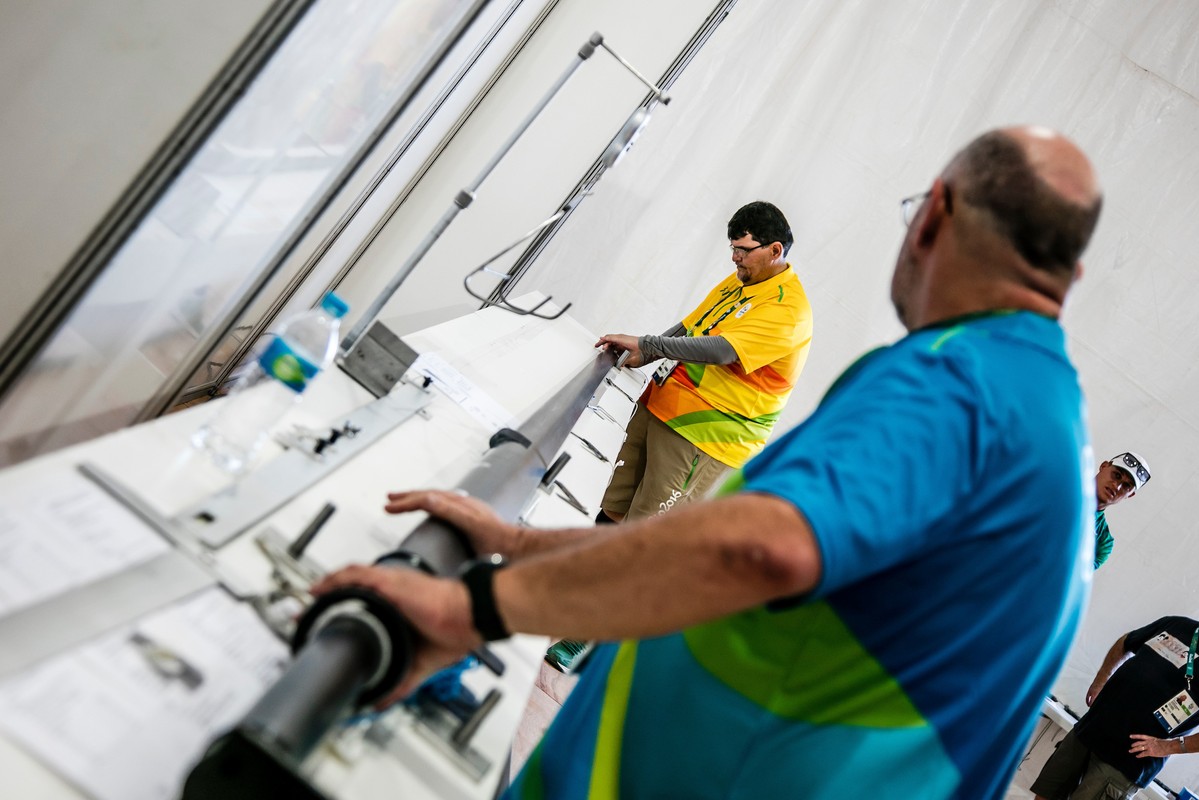
The measurement process before the start of the Olympic Games is more rigorous than anything else in the world of small boat competition.
Chairman of the Equipment and Inspection Committee Dimitris Dimou says, “We are allocated much more time to inspect each team’s equipment at a Games than we are at a typical class world championships. At a 470 World Championships, for example, we are given perhaps a maximum of 15 minutes per boat, whereas here in Rio we have had an hour per boat.”
But the measurement checks don’t stop once the start gun fires. At any point in the competition, any team can be subject to a spot-check on the water or when they come ashore. And then there are those extraordinary, unpredictable situations such as we saw on day eight of the sailing competition when the 49er and 470 fleets were caught up by the sudden arrival of a weather front that saw wind readings up to 50 knots. Some crews survived the storm better than others, and sailors came ashore mostly intact but with tattered bits of dacron from shredded sails, jibs in particular.
With each team only permitted to measure in one set of equipment for the Games, sailors need to apply for permission to replace broken equipment. However, so severe was the damage in the 470 fleet that it was decided to allow every team the opportunity to measure in a replacement jib.
Then there are the pre-Medal Race measurement checks where the top ten boats are quarantined and checked over to make sure they comply with class and event rules before contesting the final race. When the boats cross the finish line, everyone wants to know who the medallists are right then, not have to wait for the possibility of post-Medal Race protests.
It’s a detailed, exhaustive process, but Dimou is pleased with what his international team of experts has achieved in Rio 2016. “Here we could do things no one has ever done before. For example in the 49er we have special templates to check the shape on daggerboards and rudder blades. We didn’t want to take it for granted that they all come from the builders the same way, we wanted to check it for ourselves and we had the tools to be able to do so. We had fibre-optic cameras to be able to inspect the interior of the hulls via the bung hole at the back. And we applied similar rigorous tests on the Nacra 17.”
Dimou categorises the equipment at the Games into three distinct types. “We have the supplied equipment events with the Laser and RS:X boards, where the challenge for the manufacturers is to ensure that the equipment supplied to every athlete is exactly the same – or as near as reasonably possible – to everyone else’s. Then there are the builder-controlled classes, which are the 49er, 49erFX and the Nacra 17. And then there are the two measurement-controlled classes, the Finn and the 470. All types have their advantages and disadvantages, but in all cases, the aim for us as measurers is to ensure a level playing field.
“I am confident that at this Games everybody has a normal boat,” says Dimou. “It’s important not only for us to find people who have the wrong equipment but to show everybody that there is no magic in anyone’s boat. This is the usual gossip in the boat park. ‘Those who win, win because of special equipment.’ We can’t afford to let that happen. And because of what we do here, I don’t believe it to be true.”
Most of the time, when equipment fails measurement checks it’s because the sailor doesn’t understand the rules or wasn’t aware of the problem, says Dimou. However there are those that try to sneak things under the radar. “I’ve been measuring at my level since 1990, I’ve seen many things with people trying to pass through measurement doing silly things to save 150g. I suppose the thinking goes something like, ‘If they catch me, the worst that will happen is I fix my equipment. If they don’t catch me I sail thinking I have an advantage even if it’s only small.’
“Normally we don’t find things, the sailors are professionals. No one will risk doing something that will risk the chances of a medal. Our role is mostly proactive. If we are not present, it’s like giving them the green light to play with the equipment. We are there to be a deterrent. Also, for the Games, our regulations have been written in a way that if we find someone looking to cheat, we still have the power to send people to the jury and they could apply penalties. Here in the boat park the class rules don’t apply any more.”
Dimou accepts that his role does not invite popularity with the sailors and he says a thick skin is vital for a job in measurement. “Compared to race officers and judges, we are the ones completely exposed to the sailors. Everybody comes to us and, whether the approach is good or bad mannered, you have to listen. You have to be strong enough and cool enough to apply your own rule. There is only black or white. I have been a chief measurer for 11 years, and I know the difficult personalities. The key point is to show you know what you are doing. If the sailors understand that you know your rules, that you’re strict, not biased, they will respect you, and they will play the game by your rules. That’s good for us, and it’s good for them.”
Find information below on how to follow the Rio 2016 Olympic Sailing Competition.
RESULTS / ENTRIES
A full list of sailors racing at the Rio 2016 Olympic Games is available to view here – http://www.sailing.org/olympics/rio2016/qualification/sailors.php#.V6ZHvo6BLqM. Results will be available on World Sailing’s Olympic Website when racing starts on Monday 8 August here – http://www.sailing.org/olympics/rio2016/results/index.php#.V6ZH_Y6BLqM
LIVE TRACKING
The racing will be available to watch in 2D and 3D via the live tracking. Live tracking will be available when racing commences via – http://www.sailing.org/olympics/rio2016/multimedia/live_tracking.php
Live Tracking via the Sailviewer-3D Tablet App will be available for devices with 7″ or greater screens.
Click here to download the iOS Application – https://itunes.apple.com/us/app/sailviewer-3d/id912801278
Click here to download the Android Application – https://play.google.com/store/apps/details?id=com.stsportservice.sailviewer
COMPETITION STATUS
The Competition Status Screen feeds in straight from the Race Committee boats with the teams inputting data such as race times, course type, the status of each race and the plan moving forward. The competition status screen will be available when racing commences via – http://www.sailing.org/olympics/rio2016/multimedia/live_tracking.php
LIVE BLOGGING
Sailing journalist Craig Leweck will be following the racing LIVE on World Sailing’s Olympic Blog throughout Rio 2016. Follow LIVE here – http://www.sailing.org/olympics/rio2016/multimedia/live_blog.php#.V6dUbY6BLqM
PRESS RELEASES
World Sailing will be releasing international press releases after racing throughout the duration of the Rio 2016 Olympic Games. All the latest news and reports will be available to read here – http://www.sailing.org/olympics/rio2016/news/index.php
TELEVISION
To find out who your Olympic broadcaster is, click here – https://www.olympic.org/rio-2016/broadcasters. The following link – http://go.olympic.org/WS – will redirect you to the Rights Holding Broadcaster in your country.
SOCIAL MEDIA
Follow the event on World Sailing’s social networks:
Facebook – https://www.facebook.com/ISAFWorldSailing
Instagram – https://instagram.com/isafworldsailing/
Twitter – @worldsailing
Snapchat – Follow our Story on Snapchat, search for worldsailing
USEFUL LINKS
World Sailing Olympic Website – http://www.sailing.org/olympics/rio2016/home.php
Competition Schedule – http://www.sailing.org/olympics/rio2016/about/schedule.php
Latest Olympic Sailing news – http://www.sailing.org/olympics/rio2016/news/index.php
Online Notice Board – http://www.sailing.org/olympics/rio2016/results/notices/notices.php
Social Wall – http://www.sailing.org/olympics/rio2016/multimedia/social_wall.php#.V6ZteY6BLqM