August 13, 2016
6 minutes reading time

Nino Shmueli (ISR) is the Principal Race Officer for the Sailing events at the 2016 Olympic Games. With ten events competing amid Rio de Janeiro’s fickle winter winds, it takes careful coordination to keep the competition on schedule.
There are seven circular race areas – four within Guanabara Bay and three outside the Bay. Keeping the racers inside their assigned circle is the goal.
“Many of the race areas are positioned close to each other, but remember that the size of the circle does not necessarily mean that will be the size of the race course,” notes Shmueli. “We choose our leg lengths based on the published target times for each class, so in lighter winds the legs will be shorter.”
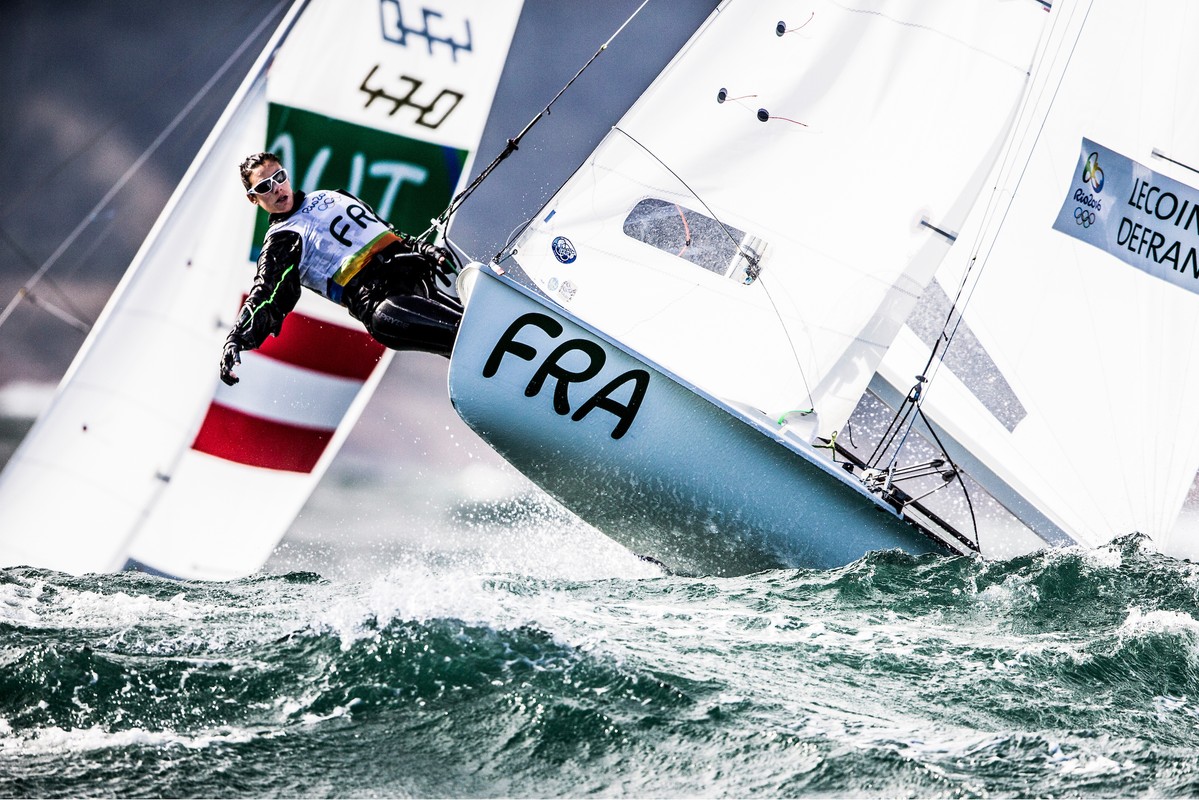
The list of 12 course options includes a trapezoid configuration which fills much more of the race area than the windward-leeward courses. The trapezoid includes two reaches to separate the competition when two fleets are raced on the same race area – like the 470 Men and Women.
“The trapezoid is more challenging for us as the laylines stretch out much further, but we still need to keep all the boats inside the race circles,” explained Shmueli. “That is why some of the race circles are up to 1.5 nm diameter while others can be .8 nm.”
To fit all these race areas in and around Guanabara Bay, shipping traffic was halted between 11:00 and 18:00. “The Navy and commercial ships all agreed on this,” said Shmueli. “The only traffic we have is the ferries that cut across the Bay between Rio and Niteroi. To accommodate the ferries, a corridor is maintained between two of the areas inside the Bay (Ponte and Aeroporto). Marks are positioned to define the corridor to assist the ferry traffic.”
Along with coordinating water traffic on the Bay, Shmueli said it was necessary to limit plane traffic at the Santos Dumont Airport located alongside the Bay. “The plane traffic was going to interfere with the helicopters needed for television broadcast so the airport halts plane activity between 12:00 and 18:00 during the Games.”
The ten fleets rotate among the race areas, which is important because two of the areas (Pao de Acucar and Escola Naval) are used for live television, and one of those two areas is along Flamengo Beach for the Medal Races. “It is a priority every day to have racing in these two course areas,” said Shmueli. “We want all the classes to get on the live broadcast, but we also want to give all the sailors experience on the area to be used for the Medal Races.
The races areas were assigned to the classes well in advance, with a maximum of five race areas being used at once during the peak of the regatta. But plans change, as they did when the winds and waves became too strong in the ocean.
“We can be flexible to change the plan if needed if the conditions – either too much or too little – require it,” explained Shmueli. “What helps us make decisions is in how we have developed a system for very accurate weather forecasts from each of the race areas.”
A weather service gives Shmueli hourly updates from 08:00 to 20:00 which provides valuable information about the wind and sea state. “We also have buoys on the Bay that give us real-time information online,” shared Shmueli. “Lastly, members of our team will go to the race areas in advance to confirm the information. This helps us make our decisions. “
Through all the training in preparation for the Olympic Games, Shmueli’s team has learned which of the course areas may have trouble in certain wind directions.
“The Pao de Acucar course alongside Sugarloaf Mountain is a challenge when the wind comes from 220-230 degrees,” explained Shmueli. “It becomes a very flukey area as the wind needs to bend around the mountain and can be coming to the sailors from both sides of the mountain. The winds are generally more stable on the ocean circles, but on the inside circles in certain wind directions, the winds can be quite shifty.”
Each race area is unique, as the sea state, wind and current varies widely among the seven locations. Tackling these differences, and being ready for changes to the schedule, are the keys to success at the 2016 Olympic Games.
Find information below on how to follow the Rio 2016 Olympic Sailing Competition.
RESULTS / ENTRIES
A full list of sailors racing at the Rio 2016 Olympic Games is available to view here – http://www.sailing.org/olympics/rio2016/qualification/sailors.php#.V6ZHvo6BLqM. Results will be available on World Sailing’s Olympic Website when racing starts on Monday 8 August here – http://www.sailing.org/olympics/rio2016/results/index.php#.V6ZH_Y6BLqM
LIVE TRACKING
The racing will be available to watch in 2D and 3D via the live tracking. Live tracking will be available when racing commences via – http://www.sailing.org/olympics/rio2016/multimedia/live_tracking.php
Live Tracking via the Sailviewer-3D Tablet App will be available for devices with 7″ or greater screens.
Click here to download the iOS Application – https://itunes.apple.com/us/app/sailviewer-3d/id912801278
Click here to download the Android Application – https://play.google.com/store/apps/details?id=com.stsportservice.sailviewer
COMPETITION STATUS
The Competition Status Screen feeds in straight from the Race Committee boats with the teams inputting data such as race times, course type, the status of each race and the plan moving forward. The competition status screen will be available when racing commences via – http://www.sailing.org/olympics/rio2016/multimedia/live_tracking.php
LIVE BLOGGING
Sailing journalist Craig Leweck will be following the racing LIVE on World Sailing’s Olympic Blog throughout Rio 2016. Follow LIVE here – http://www.sailing.org/olympics/rio2016/multimedia/live_blog.php#.V6dUbY6BLqM
PRESS RELEASES
World Sailing will be releasing international press releases after racing throughout the duration of the Rio 2016 Olympic Games. All the latest news and reports will be available to read here – http://www.sailing.org/olympics/rio2016/news/index.php
TELEVISION
To find out who your Olympic broadcaster is, click here – https://www.olympic.org/rio-2016/broadcasters. The following link – http://go.olympic.org/WS – will redirect you to the Rights Holding Broadcaster in your country.
SOCIAL MEDIA
Follow the event on World Sailing’s social networks:
Facebook – https://www.facebook.com/ISAFWorldSailing
Instagram – https://instagram.com/isafworldsailing/
Twitter – @worldsailing
Snapchat – Follow our Story on Snapchat, search for worldsailing
USEFUL LINKS
World Sailing Olympic Website – http://www.sailing.org/olympics/rio2016/home.php
Competition Schedule – http://www.sailing.org/olympics/rio2016/about/schedule.php
Latest Olympic Sailing news – http://www.sailing.org/olympics/rio2016/news/index.php
Online Notice Board – http://www.sailing.org/olympics/rio2016/results/notices/notices.php
Social Wall – http://www.sailing.org/olympics/rio2016/multimedia/social_wall.php#.V6ZteY6BLqM