August 9, 2025
3 minutes reading time

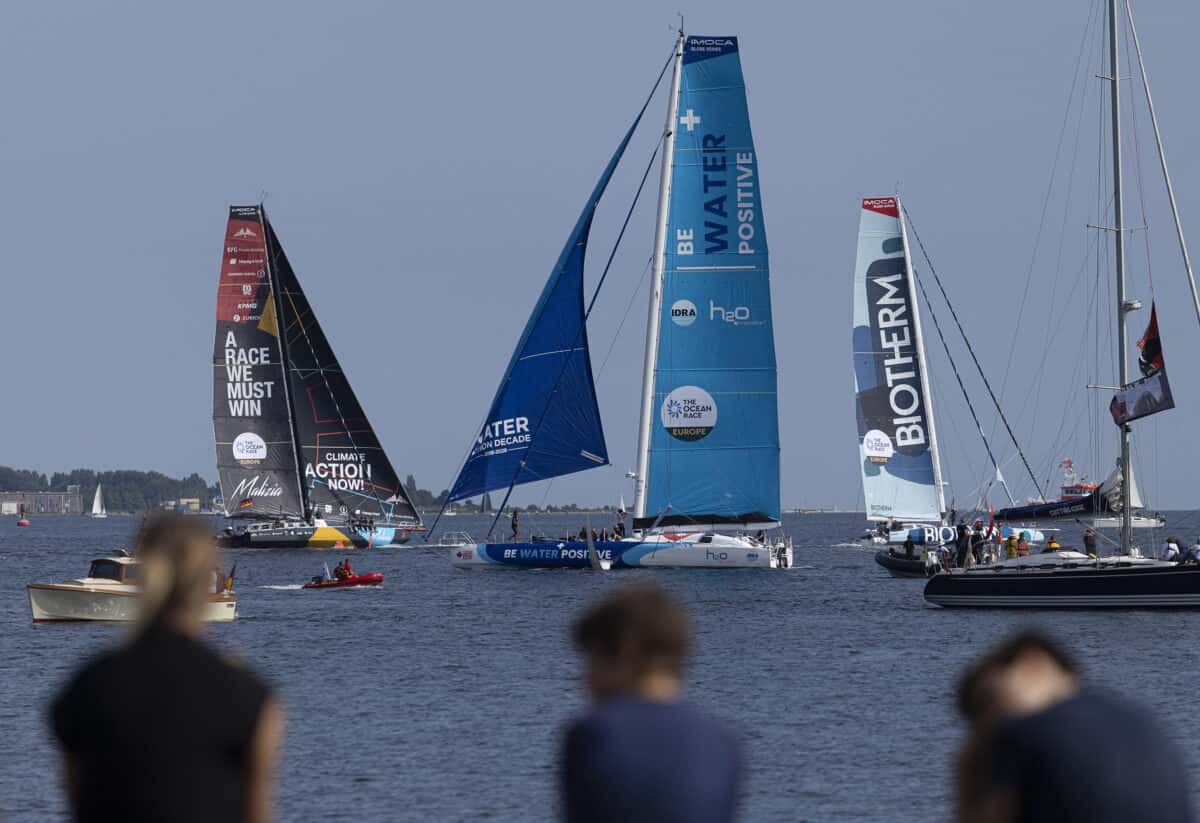
The opening leg of The Ocean Race Europe, starting this Sunday afternoon, promises to be a demanding one. On the menu between Kiel, Germany and Portsmouth, England: The Baltic Sea, the North Sea, and a long list of hazards to avoid – busy shipping lanes, sprawling wind farms, strong currents… The seven crews are expected to start with a westerly breeze before encountering several transition zones and shifting winds. All the ingredients for a fierce battle right through to a finish on the south coast of England on Thursday.

After soaking up the atmosphere in Kiel and sharing good times with the crowds filling The Ocean Live Park, the teams are getting into race mode ahead of the big departure – 15:45 on Sunday from Germany’s ‘sailing mecca’.
The public turnout is expected to be huge, on and off the waer, just as it was during the last edition of The Ocean Race.
“We came here for a ‘fly-by’ during the penultimate leg in June 2023,” recalls Will Harris from the home favourite, Team Malizia. “I was blown away by how many people came out to watch us – it was incredible.”
More than two years later, the IMOCA fleet is back, and another big crowd is expected to witness the start of what will be an intense fight to Portsmouth, the end point of Stage 1.

“In terms of navigation, this might be one of the toughest legs of the race,” says Amélie Grassi (Biotherm). “You have to break free of the Baltic, then deal with the challenges of the North Sea and avoid all the traps there. It’s very tricky sailing.”
Yoann Richomme, skipper of Paprec Arkéa, agrees. “It’s quite an unusual playground for us,” he explains. “The passage between the Danish islands is tight, especially under the Great Belt Bridge, which links Denmark’s two largest islands. The wind can be particularly fickle in the shelter of the islands.”
And it’s not just the wind they’ll be watching. “There are wind farms, oil platforms, fishing zones, and heavy maritime traffic,” notes Christopher Pratt (Canada Ocean Racing – Be Water Positive). “There are also multiple Traffic Separation Schemes (TSS), effectively ‘no-go’ areas, along the course.”
Once past Denmark, the fleet will head down the North Sea before skirting the English coast to Portsmouth. “That too can be complicated with the wind and current,” says Will Harris. “I know this stretch well down to the Isle of Wight, and it can get very tricky.”
While the end-of-leg forecast is still uncertain, the skippers now have a clearer picture for the first few days.
“We’re expecting a 15–18 knot westerly, which means we’ll start reaching which should produce some great images,” says Nicolas Lunven from Team Holcim PRB. “Then, with a high-pressure system centred over Europe, we should make good progress across the Baltic Sea. But the run down the North Sea will likely be more complicated, as the high shifts and creates transition zones with wind shifts to manage.”

Text and images courtesy of The Ocean Race. Read the full article here.