September 9, 2016
4 minutes reading time

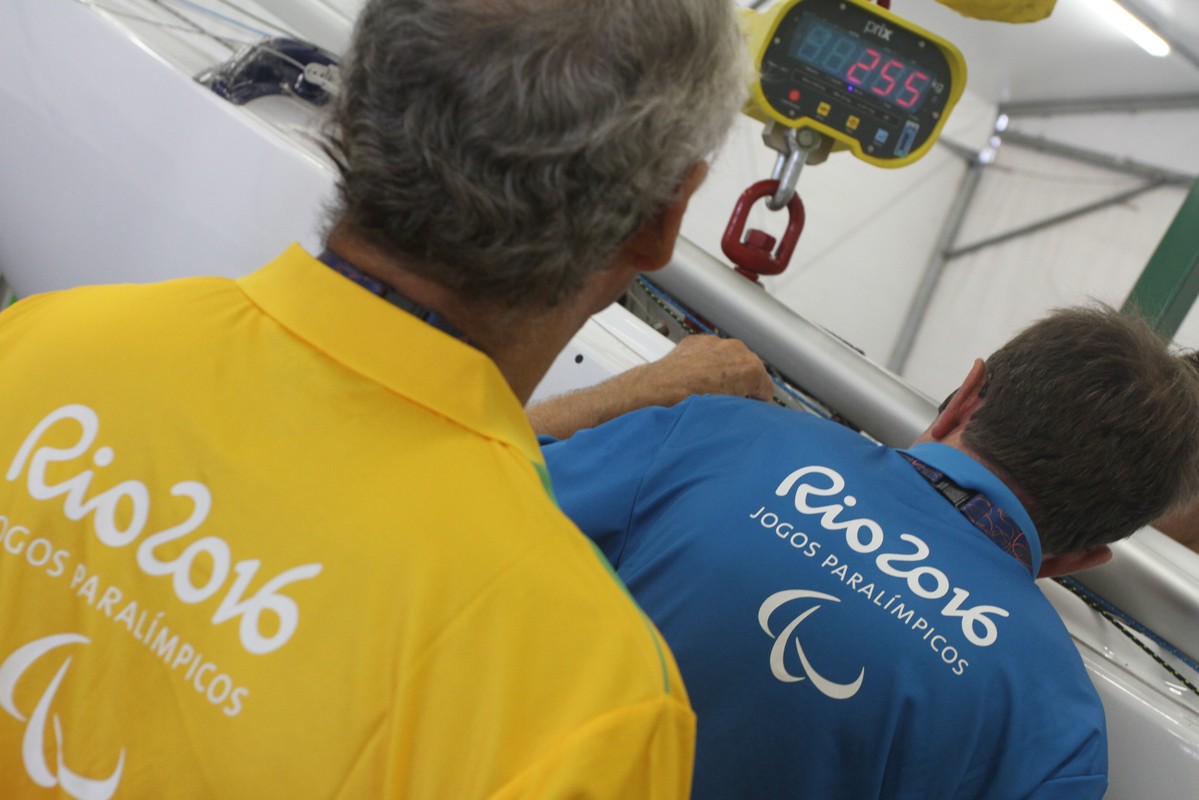
A sailor’s equipment is the extension of their ability. It is vital that the equipment, their boat, is well maintained, is at the forefront of technology and where there are equipment options, the right choice is made.
But, there are limits to how far sailors can advance their weapon of choice and these are defined in a set of rules that ensure a level playing field for the sailors.
The Equipment Inspection Committee at the Olympic and Paralympic Games have taken a leading role in this and work tirelessly, checking, measuring and weighing the boats at Rio 2016.
Firstly, Dimitris Dimou managed a group of experts at the Olympic Games and now, at the Paralympic Games, John Koopman has taken the baton and is leading a team to ensure fairness.
“We’re measuring all of the boats for all three events, the 2.4, SKUD18 and the Sonar. We do it to make sure that all the boats in the event are as equal as possible,” explained Koopman.
“We’re doing quite a number of measurements on each hull, the appendages, the spars, the sails. The boat is also weighed for total weight with keel, fin and bulb on it. Other dimensions are taken and safety equipment is checked. It’s a total measurement.”
The Olympic Games featured a wide array of sailing classes – windsurfers, multihulls, dinghies and skiffs. At the Paralympic Games, all of the classes are keelboats and generally bigger with more measurement procedures. Add Paralympic adaptations into the mix, which allow sailors of multiple disabilities to adapt the boat to suit their needs, and the process can be fairly time consuming.
“The SKUD18 has special equipment for the skipper and crew,” said Koopman. “The dimensions of the seat are very important. Some of the seating is articulated and can be on hydraulic cylinders or can be tipped from one side to the other. All of the devices are checked that they operate in a proper manner, with proper dimensions and with proper rotations.”
Over a three day period, all of the equipment is thoroughly inspected with each boat assigned an hour to go through the process. Whilst it can take the sailors attention away from what they love to do, go sailing, they appreciate the need for the process.
Koopman added, “I think the sailors realise that without it, it would be total chaos and without it they would be at a distinct disadvantage. It’s quite well received even though it can be annoying but we make it as painless as possible. You can spend a day doing it but it really is necessary for the game.”
Koopman has been working with the competitors leading up to Rio 2016 and has fulfilled the role at a number of recent Para World Sailing Championships but his career and breadth of knowledge spans many years.
“I have been measuring boats now for 48 years. I started out doing mostly ocean racing vessels, cruising club of America, MORC and then in the early 1970s I became the first measurer for the Etchells Class and I measured Stars.
“I’ve been to five Olympics now. One as a measurement co-ordinator, actually working for the Atlanta Olympic Committee and I’ve done four Olympics as the measurer for the Star.
“This is my first Paralympics. I really enjoy the competitors. I’ve done a number of Para World Championships and it’s always been very enjoyable and satisfying.”
Measurement will conclude on 10 September and then Koopman will oversee the process of post-race inspections throughout the remainder of the event, ensuring the equipment originally registered remains. In addition, if sailors break or damage equipment Koopman will be on hand to approve their replacement.
The Rio 2016 Paralympic Games will take place between 7-18 September in Rio de Janeiro and the sailing is scheduled to be raced between 12-17 September in Guanabara Bay.
Find information below on how to follow the Rio 2016 Paralympic Sailing Competition.
RIO 2016 PARALYMPIC SAILING COMPETITION
The Rio 2016 Paralympic Sailing Competition will take place at the Marina da Glória, Rio de Janeiro, Brazil and will feature 80 athletes from 23 nations competing across three events. Racing is scheduled to take place from 12-17 September 2016 and the competition format for all events is fleet racing.
ENTRIES
A full list of sailors racing at the Rio 2016 Paralympic Games is available to view here – http://www.sailing.org/paralympics/rio2016/qualification/sailors.php
PRESS RELEASES
World Sailing will be releasing international press releases after racing throughout the duration of the Rio 2016 Paralympic Games. All the latest news and reports will be available to read here – http://www.sailing.org/paralympics/rio2016/news/index.php
SOCIAL MEDIA
Follow the event on World Sailing’s social networks:
Facebook – https://www.facebook.com/ISAFWorldSailing
Instagram – https://instagram.com/isafworldsailing/
Twitter – @worldsailing
Snapchat – Follow our Story on Snapchat, search for worldsailing
USEFUL LINKS
World Sailing Paralympic Website – http://www.sailing.org/paralympics/rio2016/home.php
Competition Schedule – http://www.sailing.org/paralympics/rio2016/about/schedule.php
Latest Paralympic Sailing news – http://www.sailing.org/paralympics/rio2016/news/index.php
Online Notice Board – http://www.sailing.org/paralympics/rio2016/onb.php