August 4, 2016
7 minutes reading time
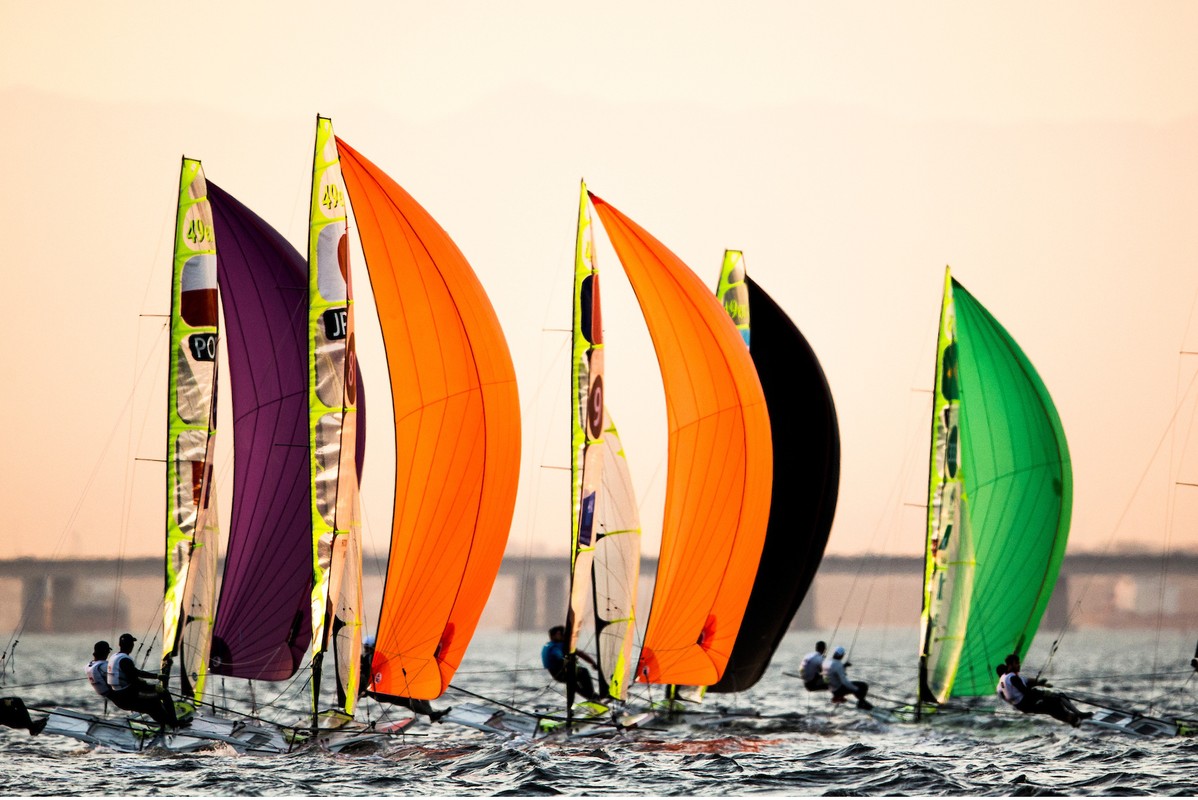
The ‘Batmobile’ of the sailing class according to a New York Times journalist, the Men’s 49er begins on the Friday 12 August, 13:00 on the Pao de Acucar course. Before they get started, find out more about the Two Person Skiff below…
Previous Olympic Medallists
Jyrki Järvi and Thomas Johanson (FIN) took first blood in the 49er on its Olympic debut at Sydney 2000. The flying Finns posted top five results in 10 of the 16 races in the new skiff class to claim their gold.
Already world champions, Iker Martínez and Xabier Fernández (ESP) didn’t let a couple of ‘off races’ throw them off their groove at Athens 2004. An 11th and two 12ths were mere blips in an impressive record which also saw them deliver top five positions in over half the races in the Olympic sailing competition. The Spanish boat topped the leaderboard from race seven to become the second ever Olympic champions in the 49er.
But, Martínez and Fernández had to settle for silver in Beijing 2008. The Spaniards were unseated by Jonas Warrer and Martin Kirketerp Ibsen (DEN). The Danes were one of the few crews to perform consistently in the vastly different conditions Beijing threw at them and wore the leaders bibs from race six. However it wasn’t all easy going for Warrer and Kirketerp Ibsen as the duo almost failed to make the final Medal Race when their mast broke shortly before the start. The Croatian team, Pavle Kostov and Petar Cupa?, who had qualified for the medal race stepped in and donated their boat to the Danish team to use in the final.
The 49ers most recent outing was a masterclass of skiff sailing as the gold went to a team from the birthplace of sailing’s speed machines. Nathan Outteridge and Iain Jensen (AUS) hadn’t missed a world championship podium in six years and exerted their dominance in Weymouth, Great Britain from early on. The Australian twosome took the yellow leaders bibs from the Danish defenders in race three and from there powered to a resounding victory.
Recent World Champions
This quadrennial has been about one boat and one boat only; Peter Burling and Blair Tuke (NZL). Silver medallists at London 2012 and virtually undefeated since, the Kiwis have done the quad, claiming all four world titles. Their streak of 27 regattas in a row, including four world titles and two Olympic test event golds is one of the most impressive in sport.
Life as an Olympic Event
In November 1996 the 49er was selected over 15 other potential high performance two person skiff classes for the Sydney 2000 Olympic Sailing program. The 49er had been the undeniable frontrunner during the proceeding trials and was an instant hit.
When it arrived on the Olympic sailing scene the fast-paced 49er offered performance, excitement and spectacle previously only found in 18 footers. Over four Olympic cycles it has evolved into a finely tuned boat that is nicely balanced in all conditions with a rig that is able to be adjusted for best performance in any windspeed and sea state.
Now in its fifth Games, the 49er event remains a firm fixture on the schedule. Expect fierce competition between nations and visual drama in spades.
What’s it like to sail?
Fast, furious and full on! In 1997 the New York Times wrote, “if Batman were a sailor, he might have considered the 49er for his Batmobile.”
The 49ers ultra-light, slight hull offers minimal resistance with no noticeable speed hump. This means it can accelerate smoothly onto the plane. The 49er’s slender solid wings make the boat much easier and safer to sail than similar performance dinghies. Along with the wings, both of the crew are equipped with their own trapeze wire, allowing them to generate a massive righting moment to control the power from the huge sail area, and continue accelerating the boat.
On the racecourse the helm makes many tactical decisions, as well as steering, and the crew does most of the sail control. This is no mean feat; to manage the sheet loads and launch and recover the massive spinnaker 49er crews have to be seriously fit.
Short History of the Class and Key Specs
The 49er was designed by Julian Bethwaite, the son of Frank Bethwaite, the man renowned as the father of high performance sailing. Julian Bethwaite created the high performance dinghy based on his leading designs of the 18-Foot Skiff, a development class known for its extreme speeds and demanding crew work.
The 49er packs three powerful sails; 20 m2 of fully battened and made of a modern laminate material called Mylar and a huge 38 m2 tri-radial asymmetric spinnaker to power a 94kg, 4.99m hull. With such enormous sails and such a slender hull the 49er gives the ultimate combination of horsepower to weight in a boat that two people can almost handle – and it’s no coincidence.
Creating a performance skiff controllable over 20 knots which benefits from easy handling, even in the most highly competitive races and toughest conditions was more science than art. The 49ers technical heritage drawn from the Australian and New Zealand skiff scenes shines through in many aspects of its design and construction. The hydrodynamic shape of the hull means it produces incredibly low drag allowing the boat to move fast. Even the bits of the hull that normally sit out of the water were given the lab treatment, optimized for aerodynamics like a race car. The wings plug into the hull seamlessly and sit low to the water to take advantage of slower air flow because of surface friction with the water.
The rig is cleverly designed so that the sail flattens in a gust to reduce its force, astute geometry has been applied in the primary shroud/forestay area to fine-tune the way the forestay is kept taut when the mast bends, holding the mid-mast forward. The 49er rig got even more technical in 2009 with an upgrade to include a larger fully carbon mast (replacing the aluminum mast) and square top mainsail to provide more sail area and to control more shape adjustment.
Famous Faces
Australia’s Nathan Outteridge tops the list of all-time greats with his Olympic Gold from London 2012 plus four golds, two silvers and two bronze at World Championships. As he sailed with Ben Austin until 2009, his current crew Iain Jensen trails by a gold and a bronze.
Close behind the Aussie skiff master are the unstoppable Kiwi duo Peter Burling and Blair Tuke with their Olympic silver plus four world titles and two second places at the Worlds. Burling and Tuke were voted Rolex World Sailor of the Year in 2015 in recognition of their incredible winning streak, one of the most impressive in sport.
Spanish pair Iker Martínez and Xabier Fernandez come next in the list of all time 49er greats with their Olympic Gold joined by three golds and a silver. Another Australian also makes the list of famous 49er faces; Chris Nicholson (AUS) holds three world titles with different crews.
Chris Draper and Simon Hiscocks(GBR) have two world titles and two second places plus Olympic bronze. Hiscocks can also boast an Olympic silver with Ian Barker.
The Croatian team from Athens 2004, Pavle Kostov and Petar Cupa?, became the second sailing recipients of the Pierre De Coubertin medal for sportsmanship, after they loaned their boat to first placed Danish team to allow them to finish the competition and win their Olympic Gold.
Did you know…
The rear of the 49er went through six years of research, development and testing before it’s designer, Julian Bethwaite, was satisfied that it would perform exactly as he intended.
RIO 2016 OLYMPIC SAILING COMPETITION USEFUL LINKS
World Sailing Olympic Website – http://www.sailing.org/olympics/rio2016/home.php
Rio 2016 Schedule – http://www.sailing.org/olympics/rio2016/about/schedule.php#.V5Yw346BLqM
Rio 2016 Olympic Sailors – http://www.sailing.org/olympics/rio2016/qualification/sailors.php#.V5Yw946BLqM