August 3, 2016
8 minutes reading time

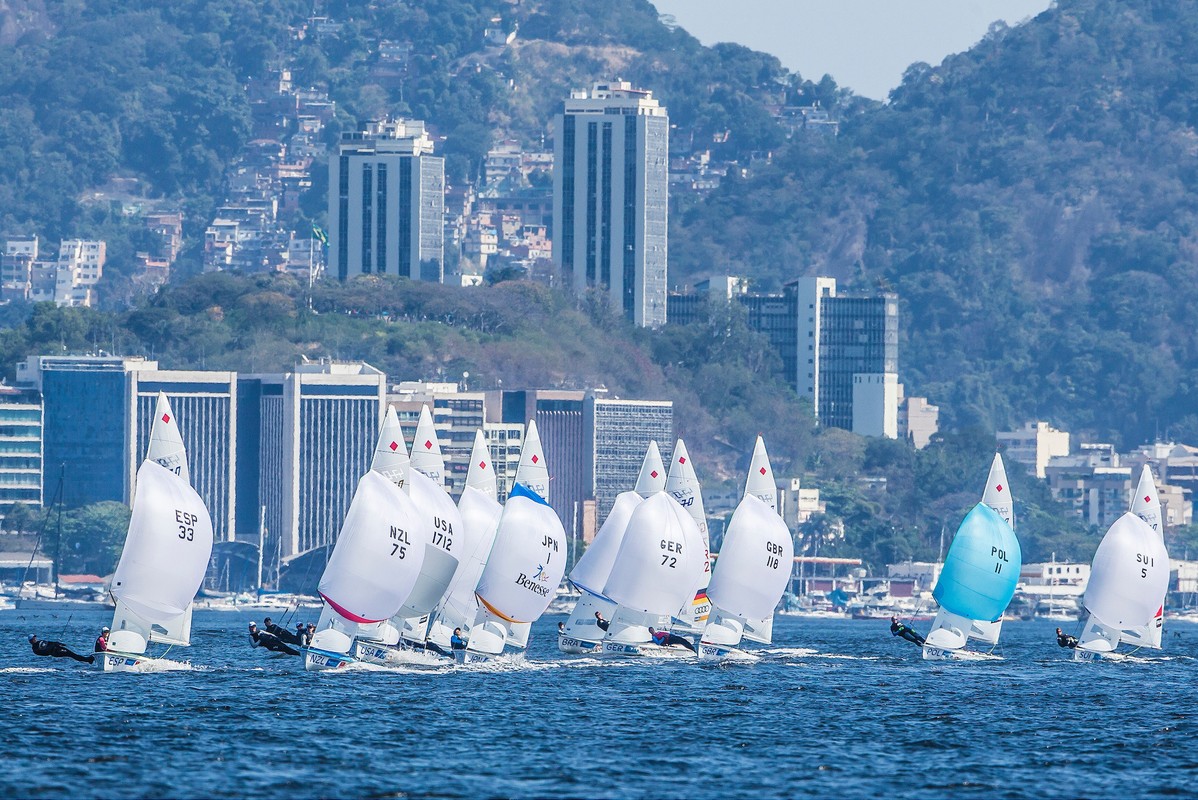
Gold and silver medallists from London 2012 return to fight it out again in the Women’s 470 which begins at 13:10 Wednesday 10 August on the Escola Naval course. There are also rising stars who could put a spanner in the works though in this open class. Before they get down to business, find out more about the Two Person Dinghy below…
Previous Olympic Medallists
The first ever Olympic Medal in the newly created 470 women was won by Allison Jolly and Lynne Jewell (USA) at the Seoul 1988 Olympic Games. The Americans were relative unknowns who had emerged unfancied – seemingly from nowhere – five months before the Games, going on to demonstrate blistering pace in all conditions. A dramatic final race saw them clinch the gold from the favourites, Marit Söderström and Birgitta Bengtsson (SWE).
After an inauspicious start, disqualified in the first race, Theresa Zabell and Patricia Guerra (ESP) put in a masterful performance to secure the gold on the second Olympic outing for the 470 women. Their triumph made it a Spanish double in the 470s as their male counterparts also topped the podium. Theresa Zabell successfully defended her Olympic title in 1996, this time crewed by Begoña Vía-Dufresne. The Spanish boat’s performance was no less impressive this time round, only once scoring outside the top ten.
The Spanish couldn’t make it three in a row in Sydney 2000, victory instead going to Jenny Armstrong and Belinda Stowell (AUS). Political turmoil in Ukraine had led to the Australian sailing team recruiting the legendary Victor Kovalenko to coach their 470s in the late nineties. His golden touch was evident as Armstrong and Stowell started the regatta as they meant to go on, with a first place. The leader’s bib was theirs from race eight and they never looked back, powering to victory on home waters.
But Athens 2004 would prove a thorn in the Australian team’s side. After barely leaving the top five ranked crews for the whole quadrennial, Armstrong and Stowell choked in defense of their Olympic title; limping home in 14th. This left home crew Sofia Bekatorou and Aimilia Tsoulfa to take emphatic victory, leading from race one.
Elise Rechichi and Tessa Parkinson (AUS) channeled the disappointment felt by a whole nation in the last Games into their performance at Beijing 2008. The Aussie crew’s results fell in the top three for more than half the competition and they led the fleet from day one. Rechichi and Parkinson’s gold took coach Kovalenko’s count of golden doubles to two and cemented his reputation as the “medal maker”.
London 2012 saw a new nation top the podium as Jo Aleh and Olivia Powrie (NZL) triumph in a battle of wits over home team Hannah Mills and Saskia Clark as the gold medal came down to the final medal race.
Recent World Champions
Over the Rio 2016 quadrennial no team has truly dominated. The last four years have mostly been a battle between three rival crews; Jo Aleh and Olivia Powrie (NZL), Lara Vadlau and Jolanta Ogar (AUS) and Camille Lecointre and Helene Defrance (FRA).
Aleh and Powrie took first blood as they claimed the 2013 World Champion crown off the back of their victory at London 2012 ahead of Vadlau and Ogar. 2014 then saw the two teams switch places as Vadlau and Ogar took the top spot while Aleh and Powrie took second. Vadlau and Ogar made it two in a row in Haifa, Israel in 2015, beating Hannah Mills and Saskia Clark and Lecointre and Defrance. Lecointre and Defrance then fought back, claiming the final world championship title of the quadrennial with Aleh and Powrie second and Vadlau and Ogar third.
Life as an Olympic Event
The 470 was selected in 1969 to fill a new event at the Olympic Games for the 1976 quadrennial, the open dinghy. In the early days of the event men and women competed together. But in this new physical class an issue quickly became apparent. Despite the immense talent of the female sailors competing on the world stage, their smaller size ultimately went against them. Over three Olympiads only two women managed to qualify for the Olympic sailing competition; Beatriz De Lisocky (COL) in 1976 and Cathy Foster (GBR) in 1984. After the 1984 Olympic Games organisers caved to demand to split the fleet into men and women and the 470 Women’s event was created.
This new women’s event quickly gained a reputation for being fiercely competitive, wire close and prone to shock upsets where previously unknown teams snatch titles from under the noses of giants. The reputation continues to this day and the medals in Rio are considered wide open.
What’s it like to sail?
The 470 is often quoted as the most challenging of the Olympic sailing events. The boat itself is not a difficult to sail, but to be competitive everything must be mastered to perfection.
With the boat so technical to set up and tactically demanding, the 470 helm must be a cerebral sailor able to understand the tuning and set up of the boat and balance this with sailing fast and racing. While the 470 crew must have the brains to perfectly set up a symmetrical spinnaker and the physicality to pump the boat to force it forward in a breeze. Excellent teamwork between the pair is essential for speed and championships are won and lost on how well helm and crew work together.
Short History of the Class and Key Specs
The 470 was designed in 1963 by André Cornu (FRA) a naval architect. The boat was conceived as a modern fibreglass planing dinghy to appeal to sailors of different sizes and ages. The class was awarded international status in 1969 and became Olympic equipment for the 1976 quadrennial as an open class before being split into men’s and women’s for 1988.
At 120kg and boasting 12.7m2 sail area plus a 13m2 traditional spinnaker, the 470 offers a large sail-area-to-weight ratio. The crew is attached to a wire trapeze to give extra leverage to keep this powerful little boat flat. All these details give the 470 performance without making it excessively difficult to handle. Because of this the boat is seen as an excellent introduction to high-performance sailing and many superstars in other classes have perfected their craft in this highly technical dinghy.
The biggest difference between the 470 and many of the other Olympic sailing classes is the ability for sailors to choose equipment from any class association licensed manufacturer. This system, known as “one design”, means that although all hulls, foils, and rigging are the same shape sailors have a small amount of flexibility to adjust their boat to suit their size and sailing style. 470 class rules prohibit the use of modern composite materials in construction which keeps the cost down as boats don’t become outdated.
Famous Faces
As with their male counterparts, the biggest name in 470 Women’s event is coach Victor Kovalenko. The women probably have more claim to the man known as the “Medal Maker” as it was in this event that he made his name. As a junior coach Kovalenko transformed his first disciples Larisa Moskalenko and Iryna Chunykhovska (UKR) from zeroes to heroes. Moskalenko and Chunykhovska lit up the Olympic Sailing competition when they claimed bronze in the first women’s only competition in 1988. Eight years later he coached Olena Pakholchyk and Ruslana Taran to bronze before emigrating to Australia and repeating the process, this time delivering gold, first with Jenny Armstrong and Belinda Stowell in 2000 then with Elise Rechichi and Tessa Parkinson in 2004.
The most successful 470 Women’s pairing of all time is considered to be Sofia Bekatorou and Emilia Tsoulfa with Olympic Gold in 2004 and four world championship titles in 2000, 2001, 2002, 2003. Just behind them are Ruslana Taran and Olena Pakholchik with two Olympic bronze medals, three world championship titles (1997, 1998 and 1999) and four second places (1995 1981, 1983 and 1984).
Only one other crew have succeeded in winning three World Champion titles; Marcelien De Koning and Lobke Berkhout from the Netherlands who won in 2005, 2006 and 2007. De Koning and Berkhout ended their partnership in style in 2008 with Olympic silver but Berkhout’s continues to shine. Two additional world titles in 2009 and 2010 and Olympic bronze in 2012 sailing with Lisa Westerhof make her the most decorated female 470 sailor of all time.
Spain’s Theresa Zabell also holds the distinction of having won the treble (1992, 1995 and 1996), but sailing with two different crew members.
There can’t be a discussion about famous faces in the 470 women without mentioning the trailblazers from the early days. Names like Claire Fountaine (FRA), the first woman to medal at a World Championship and Beatriz De Lisocky (COL) and Cathy Foster (GBR) the only two women to compete in the 470 as an open event. The names of the silver and gold medallists from the very first appearance of the 470 women event at the games in 1988 are also worthy of note. The eventual silver medallists Marit Söderström and Birgitta Bengtsson (SWE) were big players in the class in its early days, winning many major championships and the 1988 Worlds before losing out on gold to Allison Jolly and Lynne Jewell (USA) at the Games.
Home fans at the Olympics this year will recognize Brazilian duo Fernanda Oliveira and Isabel Swan who became the first female Olympic medallists in sailing for Brazil when they took Olympic bronze in the 470 Women at Beijing 2008. Oliveira will be hoping to repeat her success with new crewmate Ana Barbachan on home waters.
Did you know…
In nine Olympic Games in which the 470 Class has been raced, more than 18 different nations have secured Olympic medals in the men’s and women’s events, demonstrating the depth of participation and talent.
RIO 2016 OLYMPIC SAILING COMPETITION USEFUL LINKS
World Sailing Olympic Website – http://www.sailing.org/olympics/rio2016/home.php
Rio 2016 Schedule – http://www.sailing.org/olympics/rio2016/about/schedule.php#.V5Yw346BLqM
Rio 2016 Olympic Sailors – http://www.sailing.org/olympics/rio2016/qualification/sailors.php#.V5Yw946BLqM