August 2, 2016
7 minutes reading time

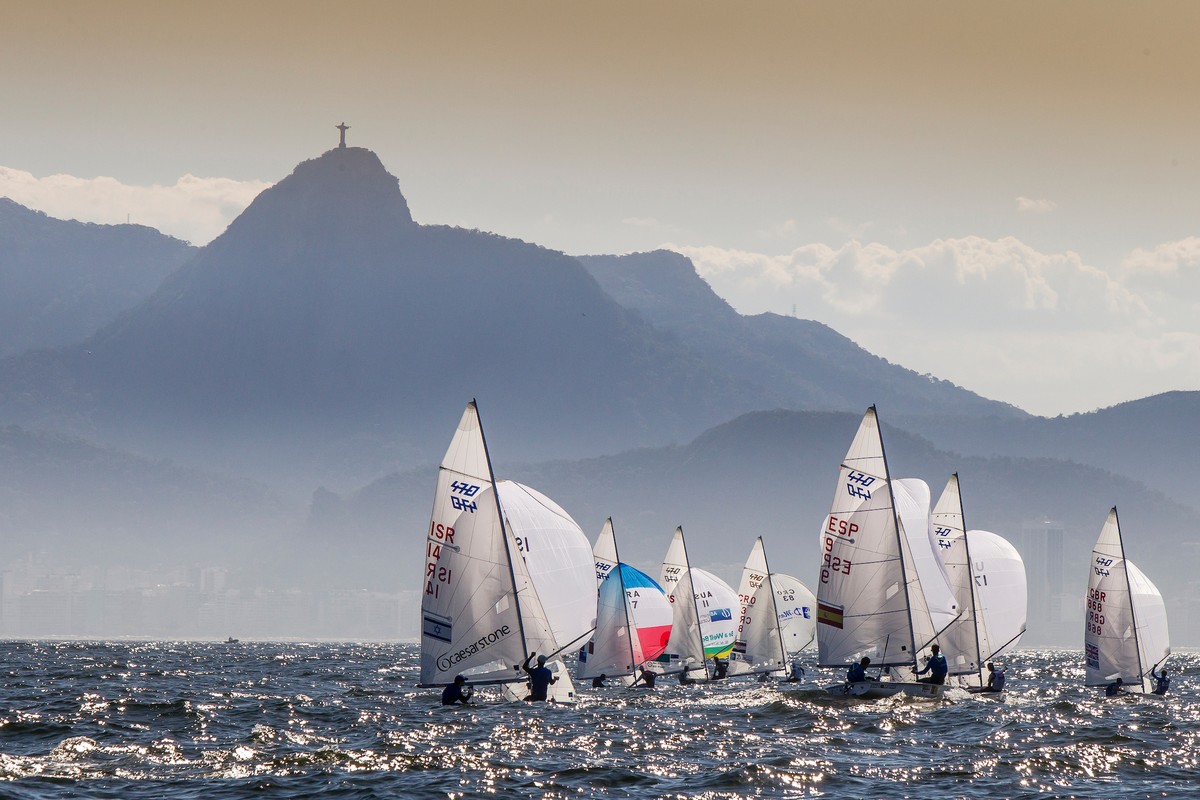
When the Men’s 470 begin their Rio 2016 Olympic Games golden quest on Wednesday 10 August, one coach will be heading out to the Escola Naval race course to see if he can ‘make’ another gold medal for his team. But before then, find out more about the Two Person Dinghy below…
Previous Olympic Medallists
The first ever Olympic Medal in the 470 was won by Frank Hübner and Harro Bode (GER) at the Montreal 1976 Games after a close battle with the Spanish, Australian and Russian crews.
The second Olympic outing for the 470 provided drama for another reason. Despite a boycott of the Moscow 1980 Games from several nations, competition was still strong so victory by a less well known team, Marcos Soares and Eduardo Penido (BRA), surprised the sailing world. The Brazilians excelled under pressure, topping the leaderboard from day two.
It was the third outing of the Class in Olympic sailing competition in 1984 where the strength of the Spanish 470 fleet finally shone through on the Olympic stage as Luis Doreste and Roberto Molina dominated. However, it was seventh placed helm Catherine Foster (GBR) who drew attention as the first and only woman competing in the then mixed fleet, prompting calls for a separate Mens and Women’s event. These calls were answered for the 1988 quadrennial as the 470 event was split by gender. France’s Thierry Peponnet and Luc Pillot’s gold was again overshadowed by drama further down the fleet as the dramatic rescue of Joseph Chan and Siew Shaw Her (SIN) by selfless Finn competitor Lawrence Lemieux grabbed headlines all over the world.
In 1992 a second Spanish crew, Jordi Calafat and Francisco Sanchez, took the top step in their home Olympics in Barcelona. The Spanish boat once again showing total domination over the fleet. But Calafat could not defend his Olympic title. The Spaniard only managed ninth place as Yevhen Braslavets and Ihor Matviyenko (UKR), an unfancied duo from a new nation created by the dissolution of the Soviet Union arose victorious at Atlanta 1996. Their incredible performance was credited to their Ukrainian coach, Victor Kovalenko, who would later be known as “the medal maker”.
Political upheaval in Ukraine led to Kovalenko being recruited by the Australian sailing team to coach their 470s. With Kovalenko on board, Tom King and Mark Turnbull began the awesome Aussie charge that continues to this day. The duo emerged triumphant from a close duel with the American boat to take gold in home waters at Sydney 2000. Athens 2004 put a spanner in the Australian machine; while the much feted Aussie boat wilted under the pressure, Paul Foerster and Kevin Burnham (USA) pulled out all the stops to clinch gold. Fired up after the disappointment of Athens, the Aussies were back on top form for Beijing 2008 as Nathan Wilmot and World Sailing’s very own Malcolm Page romped to an emphatic victory with a string of results that saw them only leave the top ten once.
Mat Belcher and Malcolm Page made it an Australian double in 2012 as they battled back to take the gold from the home team, Luke Patience and Stuart Bithell. Belcher, now crewed by Will Ryan, is the defending gold medallist and boat to beat in Rio.
Recent World Champions
The 2016 quadrennial has been dominated by the Australian duo Mat Belcher and Will Ryan who won three of the World Championships before being dramatically dethroned by Šime Fantela and Igor Mareni? (CRO) in 2016.
Life as an Olympic Event
Following equipment trials for the 1976 quadrennial the 470 was selected in 1969 to fill a new event at the Olympic Games, the open dinghy. In 1988 organisers caved to demand to split the fleet into men and women and the Men’s 470 event was created.
Both 470 events are renowned for close racing, and the boat is known as the most ‘technical’ class in the Olympic Games. Changes in technique, particularly the intensity of boat pumping allowed, over the past few years have been dramatic, adding another level to an already tricky class. The 470 is a complex animal to tame and only the very best rise to the top.
The 470 Men traditionally sees strong performances from Spanish, American and British crews although more recently the class has been dominated by the Australians and Croatians. But look out for surprises in Rio; the tricky nature of the 470 Men often sees those considered outsiders topple the more fancied crews.
What’s it like to sail?
The 470 is often quoted as the most challenging of the Olympic sailing events. The boat itself is not a difficult to sail, but to be competitive everything must be mastered to perfection.
With the boat so technical to set up and tactically demanding, the 470 helm must be a cerebral sailor able to understand the tuning and set up of the boat and balance this with sailing fast and racing. While the 470 crew must have the brains to perfectly set up a symmetrical spinnaker and the physicality to pump the boat to force it forward in a breeze. Excellent teamwork between the pair is essential for speed and championships are won and lost on how well helm and crew work together.
Short History of the Class and Key Specs
The 470 was designed in 1963 by André Cornu (FRA), a naval architect. The boat was conceived as a modern fibreglass planing dinghy to appeal to sailors of different sizes and ages. The class was awarded international status in 1969 and became Olympic equipment for the 1976 quadrennial as an open class before being split into men’s and women’s for 1988.
At 120kg and boasting 12.7m2 sail area plus a 13m2 traditional spinnaker, the 470 offers a large sail-area-to-weight ratio. The crew is attached to a wire trapeze to give extra leverage to keep this powerful little boat flat. All these details give the 470 performance without making it excessively difficult to handle. Because of this the boat is seen as an excellent introduction to high-performance sailing and many superstars in other classes have perfected their craft in this highly technical dinghy.
The biggest difference between the 470 and many of the other Olympic sailing classes is the ability for sailors to choose equipment from any class association licensed manufacturer. This system, known as “one design”, means that although all hulls, foils, and rigging are the same shape sailors have a small amount of flexibility to adjust their boat to suit their size and sailing style. 470 class rules prohibit the use of modern composite materials in construction which keeps the cost down as boats don’t become outdated.
Famous Faces
The most famous face in the Men’s 470 is not a sailor, but a coach. The 470 is the domain of legendary supercoach Victor Kovalenko. The man known as the “Medal Maker” has coached the gold medal winning crew in four of the last five Olympic Games; Yevhen Braslavets and Ihor Matviyenko in 1996, Tom King and Mark Turnbull in 2000, Nathan Wilmot and Malcolm Page in 2008 and Mat Belcher and Malcolm Page in 2012. Kovalenko is currently Head Coach of the Australian sailing team and coach to dominant 470 men’s duo Mat Belcher and Will Ryan – hotly tipped for gold in Rio
If any pairing can tip the medal maker’s crew off the top spot it’s Šime Fantela and Igor Mareni? (CRO) who won the World Championships in 2016 in dramatic fashion, ending an Aussie streak which had stretched back to before the London 2012 Games.
Where the Australian’s have made the top of the Men’s 470 their home, the British are the perpetual runners-up. British sailing stars John Merricks and Ian Walker (Atlanta 1996), Nick Rogers and Joe Glanfield (Athens 2004 and Beijing 2008) and Luke Patience Stuart Bithell (London 2012) have the bittersweet record of four silvers over the last five Games.
Eras of dominance by a nation or nations characterize the 470 Men and the impressive performances of big names in the 470 like John Shadden, Charles McKee, Paul Foerster and Kevin Burnham (USA); Thierry Peponnet, Luc Pillot, Nicolas Charbonnier and Olivier Bausset (FRA) or Luis Doreste, Roberto Molina, Onán Barreiros and Aarón Sarmiento (ESP) have inspired generations of young sailors to get out on the water.
The 470 men has also seen many sailors shine, no matter who they’re sailing with, examples include; Juan de la Fuente (ARG), twin brothers Tõnu and Toomas Tõniste (URS/EST) and Stuart McNay (USA).
While not strictly a 470 men star, one former 470 sailor has made a name for himself in another class. 49er superstar Peter Burling (NZL) sailed 470 briefly before switching to the high performance class in which he has utterly dominated with Blair Tuke in recent history.
Did you know…
The 470s name refers to the overall length of the boat in centimeters – 470cm or 4.7m.
RIO 2016 OLYMPIC SAILING COMPETITION USEFUL LINKS
World Sailing Olympic Website – http://www.sailing.org/olympics/rio2016/home.php
Rio 2016 Schedule – http://www.sailing.org/olympics/rio2016/about/schedule.php#.V5Yw346BLqM
Rio 2016 Olympic Sailors – http://www.sailing.org/olympics/rio2016/qualification/sailors.php#.V5Yw946BLqM